I want to offer ‘done for you solutions’ for users inside certain pickaxes….. think: instead of here are 30 social media ideas….. for $27 one time (or a month) we will deliver you your whole social media strategy and campaigns…..
how can I do this? How can I offer these products and take payments?
There are a few ways to do this and others here may share different approaches as well. One sensible way to think about it is this:
On Pickaxe, the current currency for end users is per AI interaction (credits). As a builder, you control how many credits users get. Many Pickaxers give a small number of free credits so users can test the tool and decide whether it’s worth paying.
For “done for you” offers, giving the full output upfront usually doesn’t work. If users get everything first, they either leave happy without paying or stay unhappy and still don’t pay.
The tricky part is the preview or partial output, and that’s a real design decision. There’s no single right answer. It depends entirely on the product. For example:
A free version might give only text, while the paid version includes visuals, PDFs, or calendars
Free users might get shorter or higher-level responses, while paid users get detailed, structured plans
You could allow 3–5 uses for exploration, then lock deeper or more advanced outputs behind payment
These are just hypothetical examples. The right setup depends on what you’re selling and how you want users to experience value before committing.
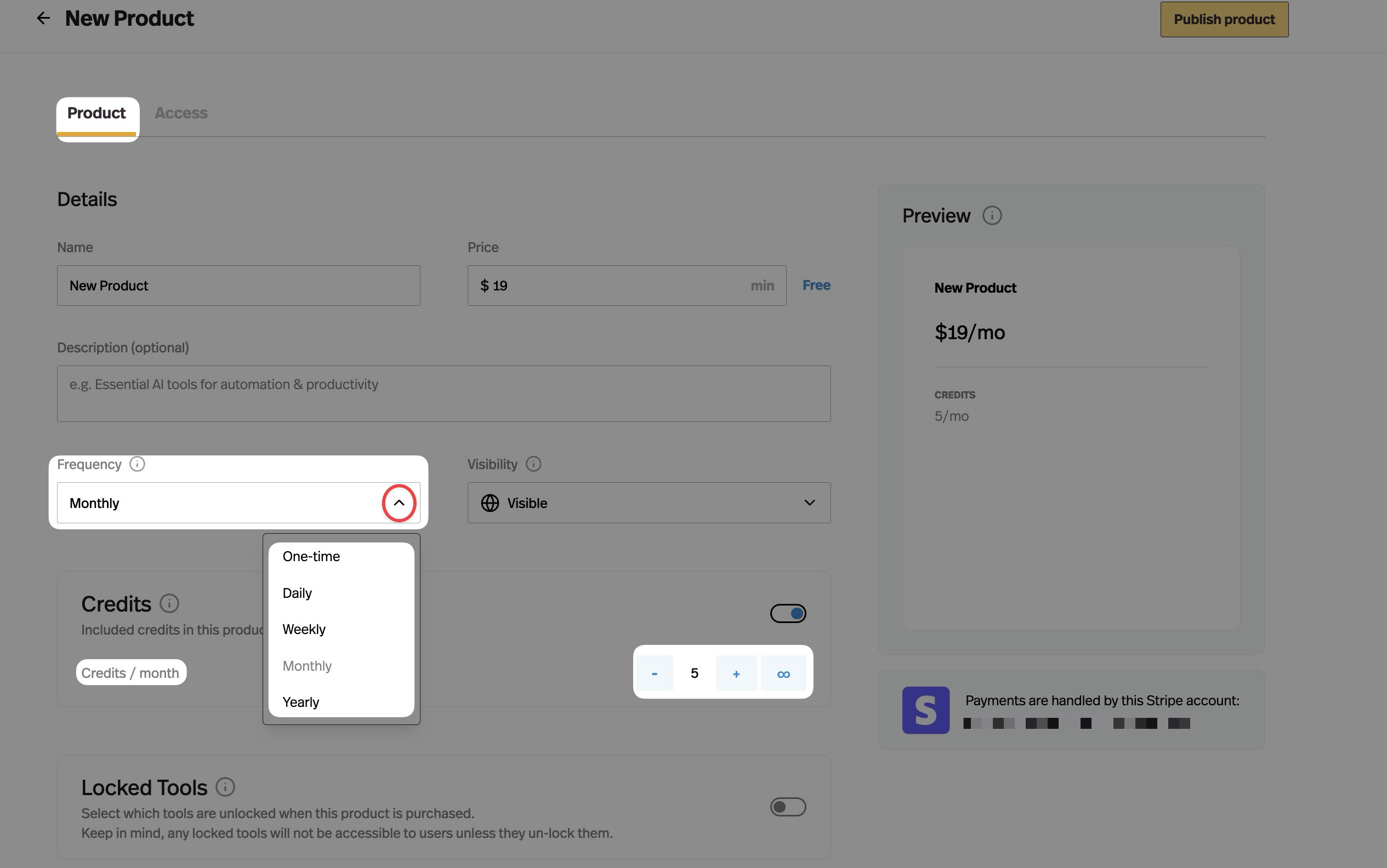
From a where/how perspective, this all happens in your Studio. You create a Product in the Access tab, connect Stripe, and include only the Pickaxes you want behind that Product. Free credits, usage limits, and paywalls are all controlled there. Once that’s set, Pickaxe handles the payments and access, and you focus on designing the experience.
Hey @abhi - Your example is good, and I have a similar challenge, but messier. In our app, we show some GPT 1.5 images as “concepts”, then we allow NanoBanana editing, then we send the final winning image for shopping of the component items.
for the OP your answer is that the Pickaxe should do something free as a teaser, and require subscription for the full product. I think that kind of works, that the OP would probably want to deliver the 30 social media posts outside of Pickaxe in a zip file.
In our case, we have 3 “tiers”, which we can probably simplify to 2, but if we want to charge 1 for 5 concepts, and .60 for each credit, and $100 per shopping run, there seems to be no way to do that…or even two of them…
To me, it looks like the OP’s question is still open, but can mostly be covered by a subscription, but likely better to webhook out to a separate billing system, because that actual service delivery is outside of Pickaxe.
I think we have a more pure-play upsell scenario, which is why we were asking about detailed subscription verification (you can’t automatically do the 100 thing because you happen to have some .60 credits. We want to verify $100 credits before allowing the action…
Can you please propose a solution whereby we can check for those $100 credits?
IN my case I do already have a subscription model in place, but what I want to do is upsell even with the subscription. End of day, users can use my model but it still takes alot of time and energy to compose a full response. What I want to include in the ‘packages’ is just that.. a full package of all the things together at one time.
Hey, @beaupierce - can you be as clear as I was about your pricing tiers?
I think you are saying that counting “credits” works for, in your example, the list of ideas? Or per individual idea? which?
But, then you want to sell something that’s not directly tied to credits/clicks/AI interactions and there’s no way to do it? That’s our situation as well.
The core of our application is counting AI interactions for image editing, but them the shopping should be an in-app “upsell” or premium feature. In our case, we want to say - “only allow the shopping option if they have a Shopping subscription, and handle the sale if they don’t”. It’s like we could do chaining, but I think that kind of got iced for lack of community interest at that time.
Our “chain” would be passing the final image from our image editor PA to our shopping one. @abhi Is that the right idea? Sounds like it might work for @beaupierce , too.
I don’t want to use a credit system… for my audience they truly don’t understand that.
I charge a monthly subscription fees $97 for unlimited use. I want to charge upsell of $27, $37, etc for certain groups of packages/courses of goods I can digitally deliver.
Understanding credits is actually important to protect your business. Offering unlimited credits can sometimes do more harm than good. With unlimited access, a user could keep regenerating full “done-for-you” outputs forever from a single payment.
When you create a Product, you can choose One-time payment (as shown in the screenshot). This works well for “done-for-you” offers like full strategies, campaigns, or presentations.
Credits are simply how Pickaxe measures usage behind the scenes.
1 AI interaction = 1 credit.
If a user submits a prompt and gets the full output in one response, that’s still just 1 credit, even if the output is large.
How you set credits depends on your offer:
If the full package can be delivered in a few messages, 20–30 credits usually works well
If you set unlimited credits, users can keep generating new presentations or packages forever, which typically doesn’t make sense for a one-time “done-for-you” product
It’s also worth keeping in mind that every AI interaction has a real cost for the builder. Even if a user pays once, unlimited regeneration still consumes your Pickaxe credits in the background, and over time that can add up.
Most builders use limited credits for one-time packages so users can refine or retry a bit, without opening the door to unlimited regeneration.
There’s no one-size-fits-all setup. Every audience and product is different. The best approach is to run small trials, watch how users actually behave, and then adjust credits and pricing until it feels right for your situation.